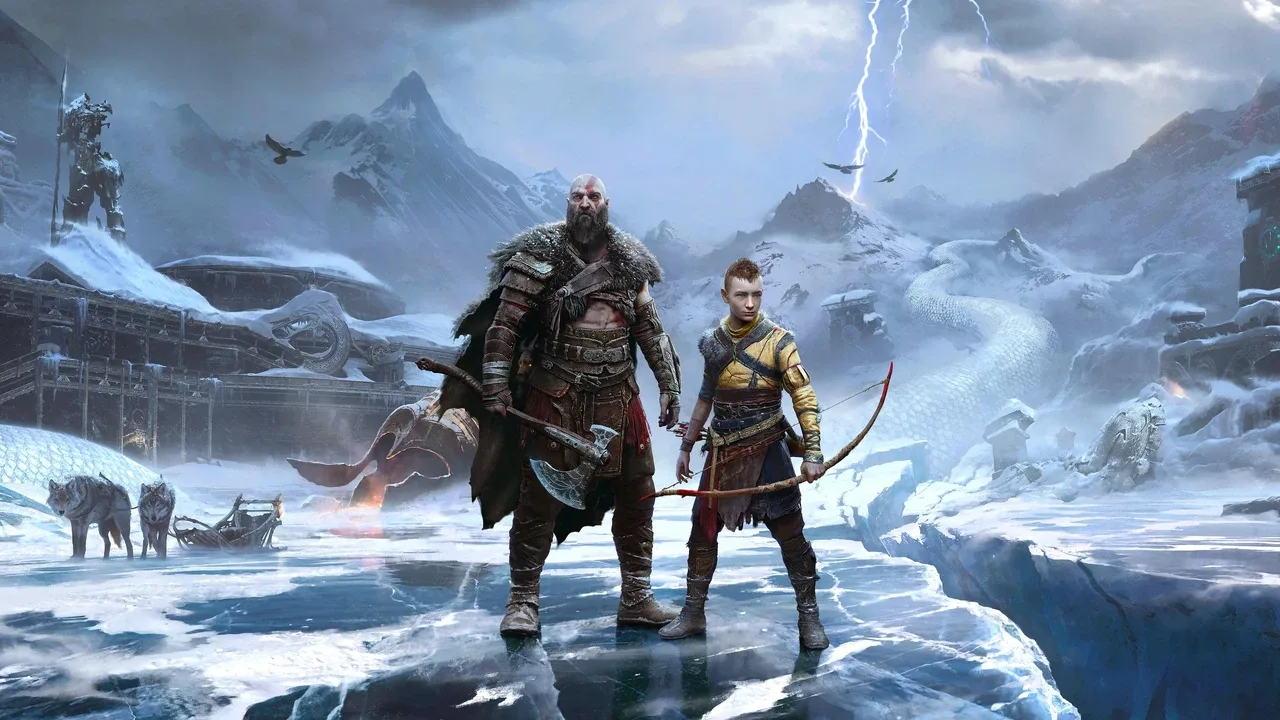
Credit: Image Credit: Santa Monica Studio
review
God of War Ragnarök won me over when it stopped trying to be huge
April 15, 2026·8 min read

Dylan Turck
God of War Ragnarök gives me more of what worked in 2018, but it is at its best when it steps away from the noise and lets its characters carry the weight.
God of War Ragnarök had an easy pitch and a difficult job. It was the follow-up to one of Sony’s biggest games, and on the surface it looked like the usual kind of sequel. More realms. More enemies. More story. More scale. I expected a very good version of the same thing. What surprised me was how often the game pulled me in through its quieter moments instead.
That is what stayed with me. Yes, Ragnarök is full of big fights, giant creatures, and scenes clearly built to make you sit up straighter on the couch. But the parts I kept thinking about were the ones where Kratos and Atreus were just talking, or failing to talk, or trying to understand each other and falling short. For all its size, this is a game that works best for me when it stops pushing so hard and simply lets people be in the room together.
The combat feels fuller without losing its bite

The first thing I noticed was that the fighting felt more open than it did in the 2018 game. I still had that same sense of weight behind Kratos, but I also had more ways to handle a fight once things started getting crowded. Swapping weapons, freezing one enemy, burning another, stunning someone who got too close, using a companion at the right moment, and trying not to get boxed in all made combat feel more active this time around.
That helped a lot because Ragnarök throws more at you. The enemy mix is better, the arenas are busier, and the boss fights do a better job of breaking up the rhythm. I was not just repeating the same few actions and waiting for the next cutscene. I had to pay attention. I had to adjust. When a fight went badly, it usually felt like I had gotten lazy or impatient.
I also liked that the game did not wait forever to let the combat open up. Once I had a few more tools to work with, the fights became much more fun to solve. That word matters here. Solve. I was not simply reacting. I was reading the space, deciding which enemy needed to go first, and figuring out when I could afford to be aggressive. The combat still has the heavy feel that made the previous game work, but this time it has more movement in it, more mess, and more room for me to recover when a plan fell apart.
I cared most when Kratos stopped acting like a monument

Kratos is still a huge presence, and the game never lets you forget it, but I liked him most when he was not smashing something. I liked him when he was trying to be careful with Atreus and not quite getting it right. I liked him when he had to listen instead of lecture. I liked him when the game let him sound tired, worried, or unsure.
That is where Ragnarök feels stronger than a lot of sequels built on scale. It does not just make the world bigger. It keeps pressing on the relationship at the center of it. Atreus is older now, more confident, and much more willing to act on his own ideas. That changes the whole mood of the story. The first game was about learning to travel together. This one is about what happens when that bond starts to strain.
The supporting cast helps a lot too. Some characters bring warmth, some bring tension, and some just make the room feel more complicated the second they walk into it. The best scenes are not the ones where the game is trying hardest to impress me. They are the ones where people say the wrong thing, hold something back, or finally admit what they are afraid of. That is when Ragnarök feels most alive.
The side paths are good enough to pull me away from the main story

A lot of story-heavy games treat side content like padding. Ragnarök does not. Some of my favorite stretches in the game came from turning away from the critical path and seeing where a favor or a side area led.
What I liked is that these detours rarely felt empty. They usually gave me one of three things: a good fight, a useful reward, or more time with the characters in a way that actually added something. Sometimes I got all three at once. That made the world feel generous instead of bloated. I was not wandering off because I felt obliged to clean the map. I was wandering off because the game had taught me that doing so was usually worth it.
The realms themselves also benefit from that structure. They are not all equally memorable, and some are stronger than others, but the game does a good job of making each place feel like it has its own mood and its own problems. That variety helped the adventure keep moving for me, especially once I got to the point where I was happy to spend time away from the main story and see what else had been tucked into the world.
It is a long game, and I did feel that length

This is where the review turns a little. I like Ragnarök a lot, but I do not think all of it is equally sharp.
There were stretches where I could feel the game hanging around longer than it needed to. A puzzle room would go on a bit too long. A section that should have felt tense would start to drag. A story beat would get explained again when I had already understood it the first time. None of this ruined the game for me, but it did make me notice the effort of moving through it in a way I did not always want to.
The puzzle hints are the clearest example. Companions are often too quick to speak up, and it can make the game feel slightly impatient with the player. I would walk into a room, look around for a second, and already hear someone nudging me toward the answer. It is a small thing until it keeps happening, and then it becomes part of the experience. I never felt stuck for long, but I also did not always feel trusted to figure things out at my own pace.
That is the broader issue I had with Ragnarök. It gives me a lot, and much of that “more” is good. Better fights. Better side content. Better enemy variety. But it can also feel overfull. I admired the craft all the way through. I just did not think every part of it needed the amount of time it was given.
The game looks expansive, but that is not why I would recommend it

Ragnarök is clearly a massive production. The realms look great. The creatures are detailed. The animation work carries a lot of the emotion in close scenes. The whole game has the kind of care you expect from a major Sony release.
But that is not why I would point people toward it. Plenty of expensive games look good and leave very little behind once the credits roll. Ragnarök works for me because there is something under all that craft. The fights are fun enough to carry the action. The side content is strong enough to justify slowing down. Most importantly, the story has real feeling behind it, especially when it narrows its focus and lets the characters do the work.
That is also why the flaws did not push me away. I noticed the drag. I rolled my eyes at some of the hand-holding. I thought the game could have cut a few things and come out sharper for it. But I still wanted to keep going. I still cared about where these people were heading. That made the difference.
God of War Ragnarök is an easy recommendation for anyone who liked the 2018 game and wanted a bigger, richer version of that formula. The combat is better, the side content is better, and the emotional material has more room to breathe. If you already had no patience for the previous game’s puzzle-heavy structure or its style of storytelling, this one is not likely to change your mind.
For me, though, it worked. Not because it was always tight, and not because it was constantly exciting, but because when it settled down and trusted its characters, it gave me something solid to hold onto. That was enough to carry the rest.
5/10
God of War Ragnarök
PlayStation 4PC (Microsoft Windows)PlayStation 5
Released
November 9, 2022
Developer
SIE Santa Monica Studio
Publisher
Sony Interactive Entertainment
Systems
PlayStation 4
PC (Microsoft Windows)
PlayStation 5
Tagged In
god of war ragnarokplaystation